

Introduction: The Problem and the Paradox of Digression
Writing requires unity. At the same time, writers are naturally drawn to digressions. We think of something interesting, something important, something worth saying—and we want to include it. That’s the problem.
Digressions can be interesting. In fact, they are often the most interesting parts of a piece of writing. Holden Caulfield, in The Catcher in the Rye (1951), makes exactly this point. He likes it when people digress. It’s more interesting and all.
But writing is not just about what is interesting. Writing is about making a point clear. And that requires unity. In short, writers must understand digression—not just what it is, but when it works and when it ruins everything.
What Is Digression in Writing?
Digression in writing occurs when a writer moves away from the main topic, weakening unity and clarity. While some digressions may be interesting or even insightful, effective writing requires that all ideas clearly support the main point.
Definition: Digress (verb) / Digression (noun)
1. Verb: To step or turn aside; to deviate; to swerve; especially, to turn aside or depart from the main subject or point in writing or speaking; to turn away from the right path.
2. Noun: A sentence or section of text that is off-topic—that is, it fails to address or connect to the main point.
3. Synonyms/Similar: deviate, deviation, detour, diversion, a departure, get sidetracked, off-topic.
4. Antonyms/Opposites: stay on topic, focus.
Why Students Struggle with Digression in Writing
Many students do not understand digression. They include ideas that are interesting but not clearly connected to the main point. As a result, their writing becomes unfocused, unclear, and difficult to follow.
- They mistake interesting ideas for relevant ideas
- They follow connections that the reader cannot see
- They lack a clear controlling idea or structure
From confusion to clear essays—in months, not years.
That’s what Pattern Based Writing: Quick & Easy Essay delivers.
Digression in Paragraphs
Digressions depart from the main topic. In a paragraph, if a writer digresses, they are off-topic. The unity of the paragraph is ruined by the digression, and if the unity is ruined, the coherence may also be ruined. Digressions lie outside of our Quadrant of Important and Interesting Ideas.
The Quadrant of Important and Interesting Ideas
- important and interesting
- important but not interesting
- not important but interesting
- not important and not interesting
- Digressions: Not related to the topic at hand; it may be important and interesting, but it’s off topic
Perhaps the writer will want to create a new paragraph around this topic, or perhaps not. Perhaps the writer will save the idea for a different piece of writing. Unfortunately, many of our favorite ideas just don’t belong.
Have you heard of Six Degrees of Separation? Everyone is connected to everyone else by a web of just six connections. As it relates to writing, everything is connected to everything else if you follow a string of connections out far enough. But that’s not our goal. Our goal is to include only closely connected ideas in a paragraph.
Does the idea or group of ideas help make the point clear? Does it make the current topic clearer? Please note, good writers often take the long route to making a point or explaining a topic: analogies, comparisons, examples, anecdotes, description, and more. The reader arrives at the point and thinks, “Oh, I get it!” Those are not digressions. It’s not enough for the writer to see the connection—the reader must see the connection.
A writer must always be on the lookout for digressions—things they know don’t really belong—or things that disrupt the flow of the text. Writers sometimes use tricks to try to fit in these digressions. Putting words and sentences in parentheses is one of them. Another trick is using words and phrases like “Note:” or “Please note:” If the digression is valuable, it’s certainly not the end of the world. In fact, these digressions can even be highly effective. But don’t overuse them, as they interrupt the flow of the text.
Digression in Whole Compositions
Digressions do not occur only at the paragraph level. They also occur at the level of the whole composition. At this level, a digression is not just a sentence or two. It may be an entire section that does not belong. It may be a shift in direction. It may be a new idea that takes the writing somewhere else entirely.
This often happens during the writing process. Writing is recursive. Writers move back and forth between prewriting, writing, and rewriting. They discover ideas while writing. And sometimes, those discoveries are interesting, important—even better than what they started with. But not everything discovered belongs in the final piece.
A writer must decide: Does this idea belong here? Does it strengthen the whole? Or does it take the writing in a different direction? If it does not belong, the writer has three choices: save it for later, move it to a better place, or cut it.
The difficulty is that these digressions often feel valuable. And they may be valuable. But value alone is not enough. The idea must contribute to the unity of the whole.
Why Digressions Are So Tempting
To paraphrase Leonardo da Vinci, writing is never finished—only abandoned. The writing process goes round and round until we finally say, “That’s it. I’m done.” During that process, writers constantly encounter ideas worth exploring, and that is where digressions are born.
Holden Caulfield makes a strong case for digressions. He argues that the most interesting parts of a speech are often the digressions. He even describes a class where students are punished for digressing, and he doesn’t like it. “And if the boy digresses at all, you’re supposed to yell ‘Digression!’ at him as fast as you can. It just about drove me crazy. I got an F in it.” In fact, Holden actually prefers when someone gets excited and goes off-topic—especially when what they say is interesting. “Oh, I don’t know. That digression business got on my nerves. I don’t know. The trouble with me is, I like it when somebody digresses. It’s more interesting and all.”
His teacher, however, takes the opposite view. The teacher insists on unity. If the speech is about a farm, then it should be about the farm—not about an uncle’s illness, no matter how interesting that story may be. Both perspectives are correct.
Digressions are often interesting. They may even contain truth. The road to understanding is not always a straight line. It can be a long and winding road. But readers cannot follow a path they cannot see. If the connection is not clear, the writing loses its power.
How to Teach Students to Avoid Digression
Teaching students to avoid digression starts with teaching unity. Students must learn to recognize when an idea supports the main point—and when it does not.
- Teach students to identify the main idea or controlling idea
- Have students evaluate whether each sentence supports that idea
- Encourage revision focused on clarity and focus
Reading. Writing. Speaking. Listening.
Academic Vocabulary for Absolutely Everyone! upgrades all four at once.
How Real Writing Handles Digression
In real writing, digressions are often managed rather than eliminated.
Many modern textbooks include sidebar text boxes and blurbs. Visually oriented books are often filled with them. These are, in many cases, controlled digressions. They allow writers to include important or interesting information without interrupting the main flow of the text.
Academic writing uses a similar strategy. Footnotes, endnotes, and content notes allow writers to include additional information outside the main body. These notes may clarify, explain, or expand on ideas. Sometimes, they contain some of the most interesting material in the entire text.
However, there is a trade-off. Digressions—whether in sidebars or notes—slow down the reading process. They interrupt the flow. That is why style guides often caution against overusing them. Writers, therefore, face a choice: include the idea in the main text, move it to a secondary space, or leave it out entirely.
Managing Digressions: Signals and Control
Writers sometimes signal a digression intentionally. They may say:
- “Let me digress for a moment…”
- “By the way…”
- “To return to the point…”
- “As I was saying…”
These signals help guide the reader. They acknowledge the departure and prepare for the return. This is not new. Michel de Montaigne (1533-1592), inventor of the essay genre, frequently used phrases like, “Now, to return to my subject.” The digression is controlled because the writer leads the reader out—and then brings the reader back. Without that control, the writing simply wanders.
Digression and Genre: Different Ways of Making Points
Genre is one of the most important and most overlooked aspects of writing. Genre sets the criteria for what a piece of writing should be. It is the target. Things that are required in one genre are nearly crimes in another. In the real world, genre and audience are closely connected—sometimes even synonymous.
But some principles transcend genre. Unity is one of them. Regardless of the genre, paragraphs and whole compositions must have unity, and digressions are frowned upon when they weaken that unity.
Different genres make points in different ways:
- Academic writing tries to make points clear and unmistakable. It often seeks the shortest path between two ideas.
- Informal essays may meander, but in the end, each part must contribute to the whole.
- Stories often rely on implied meaning. They show rather than tell.
In short, do not mistake a long, winding path for a digression. Some writers—like Socrates—made points by asking question after question. The path was not direct, but it was unified.
Formal Essays, Informal Essays, and the Role of Digression
Formal essays do not digress. At least, they are not supposed to. The goal of formal academic writing is clarity, precision, and unity. Formal essays move directly toward a clear point, and that point is stated early and reinforced often. In short, formal essays try to create the shortest line possible between two ideas.
Informal essays, on the other hand, often digress. But these digressions are not random. They are exploratory. They are reflective. They are part of the writer’s attempt to think on paper.
This goes back to the origins of the essay. The word essay comes from the French word essayer, meaning “to attempt.” Early essayists wrote to explore ideas, not just present them. The writing was not always direct—but it was purposeful. Even here, there is still unity.
Informal essays may wander, circle, and develop ideas gradually, but they are still built around a central idea. That idea acts as a kind of umbrella, holding everything together. The path may not be direct, but the writing must still connect.
Journal writing works in a similar way. Writers often digress not to wander, but to discover. They follow ideas wherever they lead in order to figure out what they think. In this sense, digression becomes part of the thinking process.
But what is discovered in the process is not always what belongs in the final piece. In short, writers may digress to discover truth, but they must unify to communicate truth.
If your students can’t organize a paragraph, they can’t write an essay. From confusion to clear essays—in months, not years.
That’s what Pattern Based Writing: Quick & Easy Essay delivers.
The Unity Umbrella
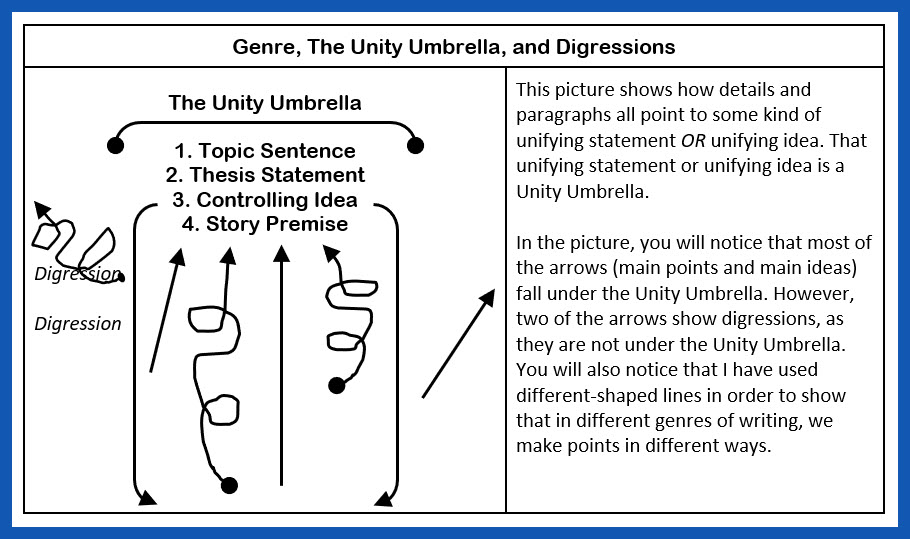
This picture shows how details and paragraphs all point to some kind of unifying statement or unifying idea. That unifying statement or idea is a Unity Umbrella.
Most of the arrows (main points and ideas) fall under the Unity Umbrella. However, some arrows fall outside of it. These are digressions. Digressions harm unity in two ways:
- They are off-topic—they do not contribute to the whole
- They stop the flow—they do not move the writing forward
Formal essays, informal essays, articles, reports, research papers, and stories all rely on unity. Digressions weaken that unity when they fall outside the structure.
The Writer’s Decision
Writing is a process of decisions. When it comes to digressions, the writer must decide what stays and what goes.
- Keep it if it strengthens the point
- Move it if it is valuable but misplaced
- Cut it if it weakens the whole
Not every good idea belongs. Not every interesting detail deserves space. This is where judgment matters. This is where writing becomes writing.
Conclusion: The Long Road and the Wrong Turn
Not all wandering is wrong. Sometimes the best writing takes the long road. It builds understanding slowly and leads the reader to a moment of clarity.
But there is a difference between the long road and the wrong turn. A long road still leads to the destination. A wrong turn leads somewhere else.
Digressions are tempting because they are often interesting. Sometimes, they are even true. But writing is not just about what is interesting. It is about what belongs. In the end, unity is the guide, and the writer must decide what belongs under that umbrella—and what must be left behind.
Final Thought: Mastering Digression in Writing
Understanding digression is essential for strong writing. When students learn to stay focused, maintain unity, and connect ideas clearly, their writing becomes more effective, more readable, and more powerful.
If you want a complete, proven system for teaching writing:
- Pattern Based Writing: Quick & Easy Essay — Best for elementary, middle school, remedial, and struggling writers
- Academic Vocabulary for Absolutely Everyone — Best for anyone who wants to improve critical thinking, logical arguments, and effective communication