

Why Students Struggle With Essays (and How to Fix It)
Most students don’t struggle with writing because they lack ideas—they struggle because they lack structure. If your students’ writing feels unfocused, repetitive, or unclear, the problem may not be effort—it may be misunderstanding.
For over 400 years, essays have been written in two very different ways—yet most students are never taught the difference. Teaching the structural and stylistic differences between formal and informal essays will help students understand the truth about writing while helping them target the type of writing they want to create.
A Brief History Teachers Should Know
When Michel de Montaigne published Essais in 1580, he introduced a new genre of writing. The term essay comes from the French word essayer, meaning to attempt. Montaigne viewed his writing as an attempt to say something worthwhile. His essays were exploratory, reflective, and often digressive—true attempts to think on paper.
More than a century later, Samuel Johnson described essays as “a loose sally of the mind; an irregular indigested piece.” That definition reflects Montaigne’s influence.
But in 1597, Francis Bacon changed everything. His essays were concise, structured, and purposeful. With Bacon, the essay became a tool for clarity—not just exploration.
This created a divide that still shapes writing instruction today:
- Informal essays (Montaigne): exploratory and personal
- Formal essays (Bacon): structured and direct
What All Effective Essays Have in Common
Every writing assignment asks students to be clear—but few students are ever shown how clarity actually works.
Regardless of type, all effective essays share two essential elements:
- A Clear Thesis (Controlling Idea)
- Unity
Even informal essays—no matter how reflective—are built around a central idea. That idea acts as an umbrella, holding everything together.
Key Insight for Teachers: If students do not understand thesis and unity, they cannot write effectively—no matter how many essays they complete.
The Spectrum: Not Just Formal vs. Informal
There is no rigid dividing line between formal and informal essays. Instead, writing exists along a continuum:
• Most Formal: Dense, formulaic, rigid
• Effective Academic Writing (Instructional Target): Logical, clear, structured, and engaging
• Most Informal: Exploratory, personal, and meandering
Instructional Insight: Strong writing instruction moves students toward clarity and control.
A Clear Comparison: Formal vs. Informal Essays
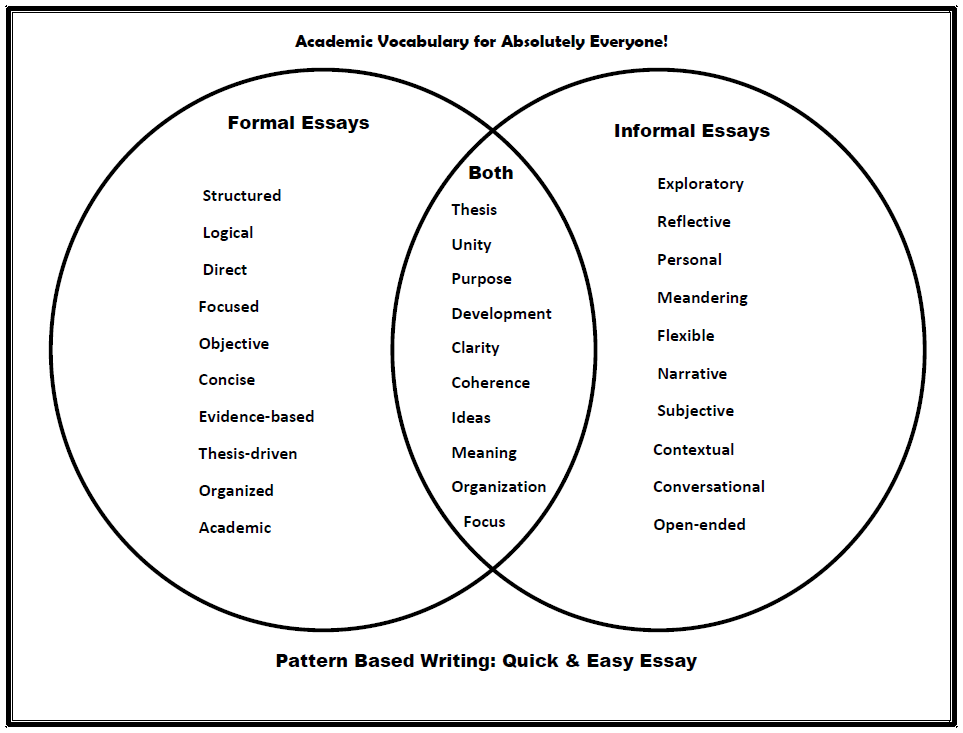
How to Read and Interpret the Venn Diagram
The words in this Venn diagram are not strict rules, but common and helpful guidelines. In real writing across the curriculum, formal and informal elements may overlap. Some effective essays may fall somewhere in between.
Both types of writing also have an important place in the classroom:
• More Informal: journal writing, writing to learn, quickwrites, and reflective responses
• More Formal: academic writing for a grade, structured essays, and formal assessments
This comparison is best used as a tool to help students understand clarity, structure, and purpose—not as a fixed set of definitions.
Effective instruction helps students know when to use each.
Formal vs. Informal Essays: The Real Difference
In the early 1900s, essayist Katharine Fullerton Gerould asked her readers a simple question: Do you want the news or the truth? She did not get the response she expected or wanted. Her readers told her they wanted the news—clear, efficient, and direct.
This distinction still applies:
- Formal essays deliver the facts
- Informal essays explore the truth
Both are valuable—but they are not interchangeable.
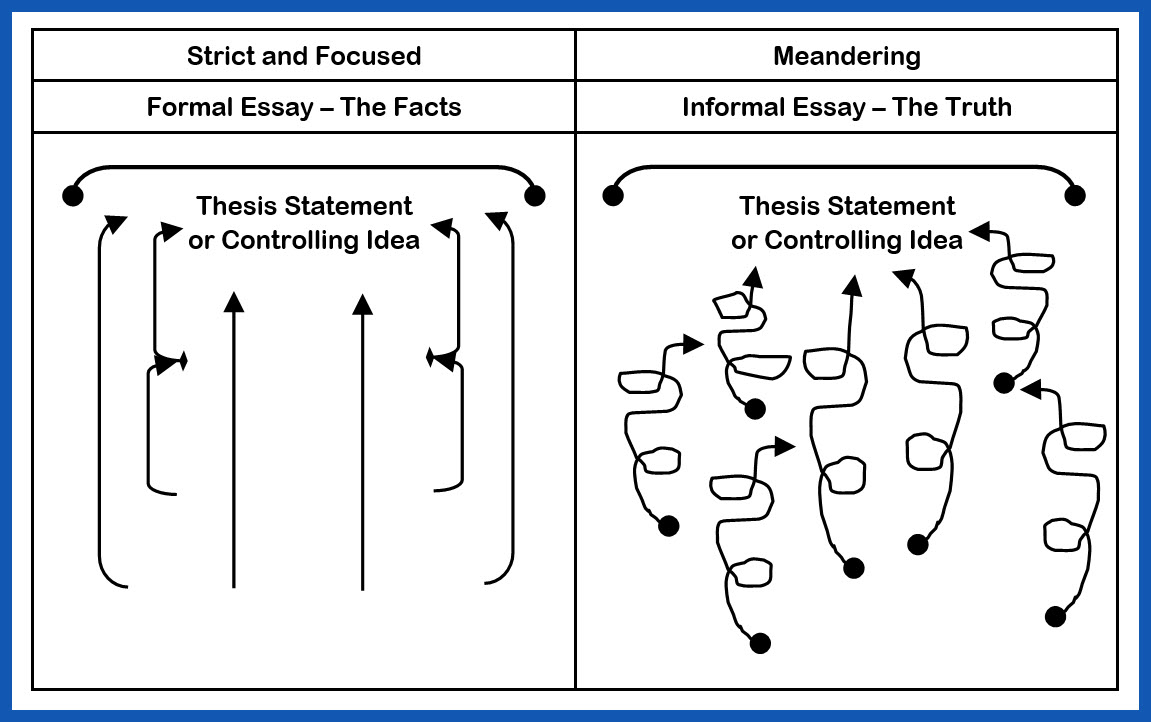
A Visual Comparison of Essay Structure
The difference becomes immediately clear when you look at structure:
How to Teach This Visual
- Both essays are unified—everything connects to the thesis
- Formal essays move directly toward a clear point
- Informal essays explore, circle, and develop ideas gradually
We all recognize the moment when someone says, “What’s your point?” In a formal essay, the point is clear early and reinforced often. In an informal essay, the reader may need to wait—and discover.
Critical Clarification: Exploration is not disorganization. Even meandering must remain purposeful.
Characteristics of Formal Essays
Formal essays are the backbone of academic writing.
Key Features:
- Clear, direct, and structured
- Focused on one main idea
- Frequent reference to the thesis
- Logical progression of ideas
- Objective tone
- Use of evidence, refutation, and concession
Instructional Priority: Students must learn to state, support, and stay focused on one idea.
Characteristics of Informal Essays
Informal essays serve a different purpose.
Key Features:
- Exploratory and reflective
- Rich in context and background
- May include personal perspective
- Allow meaning to emerge gradually
- Often less explicit in conclusions
Readers may wonder, “Where is this going?”—and that is intentional. In many cases, the journey through the ideas is the point.
Common Student Mistakes (and Why They Happen)
Most students don’t understand essays—here’s why:
They confuse:
- Length with development
- Complexity with clarity
- Exploration with lack of structure
As a result, their writing becomes unfocused. This is not a motivation problem. It is a structure problem.
Why Formal Writing Must Come First
While students benefit from understanding both forms, most academic writing is formal.
Students must be able to:
- Write a clear thesis
- Organize ideas logically
- Develop one point effectively
- Maintain unity throughout
Understanding informal essays improves reading and thinking. But clarity begins with formal structure.
Teaching Insight: Clarity Changes Everything
Clarity is not just a goal—it is the foundation of effective writing.
When students gain clarity:
- Writing improves immediately
- Confidence increases
- Instruction becomes easier and more predictable
When they don’t:
- Writing feels frustrating
- Progress is inconsistent
- Teachers are left guessing what went wrong
The Instructional Solution
If students are struggling, the answer is not more writing. It is better structure.
Pattern Based Writing: Quick & Easy Essay gives teachers:
- Step-by-step writing instruction
- Clear step-by-step models for paragraphs and essays
- Proven strategies for beginning, struggling, and remedial writers
It is designed to do what traditional instruction often fails to do: Make writing clear, teachable, and repeatable.
Final Thought for Teachers
You don’t need students to write more—you need them to write clearly and with purpose. Understanding the difference between formal and informal essays gives you a practical framework for improving student writing. When students learn how to form a clear thesis, maintain unity, and develop ideas logically, their progress becomes consistent and predictable. That is the real goal of writing instruction: not just more writing, but better writing.