

Outlines are visual. They are a visual representation—a picture—of what is going on inside a whole composition. In this article, we are going to discuss nine important concepts in writing. Interestingly, in writing, the use of these concepts is often not clearly visible. In one sense, these nine concepts are hidden within a forest of words. But in an outline, these nine concepts become quite clear.
Outlines: The Skeletons of Writing
Let me ask you a question: Do you think the skeleton inside your body is important? You can’t see it, so it can’t be all that important… right? Right? Wrong! Of course a person’s skeleton is important, even if you can’t see it. When you study the human body, you don’t spend much time looking at the outside—you look inside. It’s the same with writing. The outside (words and sentences) tells only part of the story. The real structure is inside.
An outline is the internal structure of a piece of writing. But remember, an outline is a two-way street. It exists within a completed whole composition, and it is used to build a whole composition. Sometimes you must build an outline in order to build the whole composition, and sometimes you must chip away the outside elements of a whole composition in order to discover the outline hidden within.
The Big Picture: The Goals Of Outlining
As writers, we outline for a reason. We want our writing to be excellent, and an outline is an effective tool to help us achieve that excellence. Before we look at our nine outlining concepts, let’s quickly review some vital writing concepts that help us target excellence in our writing and our outline.
Outlining Goals: The Three Most Important Concepts in Writing
- Unity: We want our writing to stay focused on one whole-composition main idea (thesis, etc.) and include only what supports that idea.
- Coherence: We want our ideas to be arranged in a logical order so that the writing flows clearly from one point to the next.
- Emphasis: We want our most important ideas to be highlighted through placement and development.
Outlining Goals: Five More Essential Concepts in Writing
- Proportion: We want our important ideas to receive more space and development than less important ideas.
- Selection: We want to choose only the most relevant and effective ideas.
- Sequence: We want our ideas to be arranged in the most effective order.
- Variety: We want our writing to include enough variation to remain engaging and effective.
- Clearness: We want our ideas to be expressed so the reader easily understands the meaning.
When we examine an outline, these concepts shine. In paragraph form, they are often difficult to see. But remember—what exists within an outline also exists within the corresponding whole composition.
The Nine Important Concepts Found in Outlines
Now, let’s learn about our nine concepts that relate specifically to outlining.
- Levels
- Hierarchy
- Division and Categorization
- Coordination and Subordination
- Parts and Wholes
- General to Specific and Specific to General (Chunking Down and Chunking Up)
- Parallelism
- Symmetry
- Consistency
Outlining Concepts 1 and 2: Levels and Hierarchy
Levels and hierarchy are both very important terms in the world of outlining. In fact, outlines are often referred to as hierarchical outlines, and outlines are often named according to the number of levels included: one-level outline, two-level outline, three-level outline, and so on.
A hierarchy is a system of arrangement based on rank, position, or importance. Items in a hierarchy fall into one of three categories:
- Superordinate: higher in rank, power, or importance
- Coordinate: equal in rank, power, or importance
- Subordinate: lower in rank, power. or importance
There are also two types of levels:
Types of Levels
- Non-hierarchical levels
- Examples: grade levels, parking structures, rainforest layers. As an example, one grade level is not more powerful or important than another grade level. Every grade level has equal importance. Likewise, the third level of a parking structure is not more important or powerful than the second level.
- Hierarchical levels
- Examples: outlines, corporate structures, military command, food chains. To be clear, a general in the military has more power than a captain. And a captain has more power than a private.
In short, all hierarchies have levels, but not all systems of levels form hierarchies.
Levels and Hierarchy in Writing
People rarely use the terms levels and hierarchy when discussing writing—but they should. There is a direct connection between the levels in an outline and the parts of a whole composition.
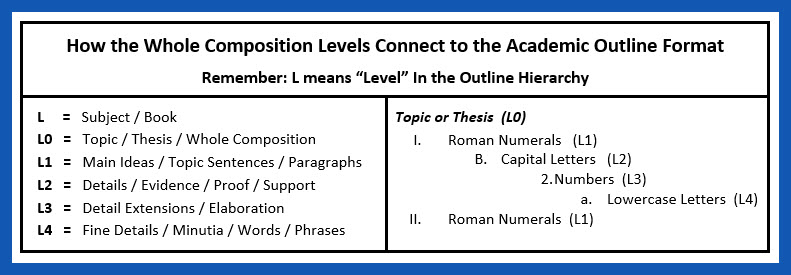
This connection is a two-way street:
- We create outlines to build compositions
- We extract outlines to understand compositions
Important Ideas About Levels
- Minutia: Small details may add meaning—or they may need to be removed
- Ground Zero: The topic or thesis becomes the starting point of writing
- Relativity: Every idea is an accordion—you can expand or shrink it
- Whole Compositions: Sentences build paragraphs; paragraphs build compositions; compositions build books
- Sentence Combining: One sentence can contain multiple levels of meaning
Outlining Concept 3: Division and Categorization
This may sound strange, but it is powerful: every item in an outline is a category. Writing is the act of dividing topics into categories. We divide a topic (category) into smaller topics (more categories), and then we write about those topics. The HIGHEST-LEVEL topic is in control of the lower LOWER-LEVEL topics.
At its most basic level, the writing process is this:
- Divide a topic into categories (ideas, reasons, causes, claims, points, etc.)
- Make statements about those categories (Note: Topic sentences were originally called topic statements.)
- Support those statements with details (explanation, evidence, description, etc.)
A paragraph is a category. A topic sentence is a statement about that category. The details support that statement.
Example of Division and Categorization in Writing
We choose the topic of PETS. We divide that up into categories. One category is CATS. We choose to write about CATS. We divide the topic of CATS into various categories: 1) what CATS do, 2) what CATS eat, and 3) how to train a CAT.
Then we start dividing each of the lower categories into categories. We divide the category of “what CATS eat” into the categories of 1) dry food, 2) wet food, etc.
In short, writing is always a process of dividing topics into categories.
Writing Success: If your students can’t organize a paragraph, they can’t write an essay. From confusion to clear essays—in months, not years.
That’s what Pattern Based Writing: Quick & Easy Essay delivers.
Outlining Concept 4: Coordination and Subordination
Few concepts are as important in writing as coordination and subordination. This is especially true in creating an outline for our writing.
- Superordinate: higher in rank, power, or importance
- Coordinate: equal in rank, power, or importance
- Subordinate: lower in rank, power. or importance
You may have heard of coordinating and subordinating conjunctions. These concepts are not just for sentences—they apply to the organization of ideas across an entire composition. In outlining, these relationships determine how ideas are arranged and understood.
- Superordinate ideas sit at the top of this structure, guiding the overall direction of the outline.
- Coordinate ideas appear at the same level in an outline because they share equal importance and develop the same superordinate main point (thesis, etc.)
- Subordinate ideas are placed beneath a higher-level idea to show that they support, explain, or provide details about it.
By using coordination and subordination effectively, a writer creates a clear hierarchy of ideas, making the structure of the composition logical, organized, and easy for readers to follow.
Outlining Concept 5: Parts and Wholes
Wholes can be divided into parts, and parts can be put together to create wholes. The concept of Parts and Wholes has meaning for nearly everything in the entire universe, including our writing.
Essential Idea: In outlining, a whole (essay, paragraph, or section) is made up of parts (main points, supporting ideas, details). At the same time, those parts work together to form a complete, unified whole.
In outlining, Parts and Wholes work closely with the previous concept of Coordination and Subordination, as well as the other key concepts, to create a clear, organized structure.
A “whole” in writing might be an entire essay, a body section, or even a single paragraph. Each of these wholes can be divided into smaller “parts,” such as main ideas, supporting points, and specific details. At the same time, those smaller parts combine to form a meaningful whole, giving the writing unity and completeness.
Whole Essay vs. The Parts of an Essay
- Whole Essay: Composed of Parts
- The Parts of a Whole Essay: Introduction Paragraph, Body Paragraphs, Conclusion Paragraph
Whole Paragraph vs. The Parts of a Paragraph
- Whole Body Paragraph: Composed of Parts
- The Parts of a Whole Body Paragraph: Topic sentence (main idea), evidence, explanation, etc.
How Parts and Wholes Connect to Some of Our Other Concepts:
- Levels: Parts appear at different levels (main ideas vs. details). All of the levels work together to form the whole.
- Hierarchy: Larger wholes sit above smaller parts in importance.
- Division and Categorization: A whole is divided into clear, logical groups of parts.
In short, Parts and Wholes help writers see both the big picture and the smaller components at the same time. By understanding how ideas can be divided and combined, a writer can create an outline that is complete, well-structured, and logically connected from beginning to end.
Outlining Concept 6: General to Specific and Specific to General
General to Specific and Specific to General: Chunking Down and Chunking Up
We can Chunk Down and go from general to specific; or we can Chunk Up and go from specific to general. When we Chunk Up and Chunk Down, we move through Levels of Specificity. Let’s take a look at seven levels of specificity:
The concept of “Level of Specificity” is a common one; and as you can see, it means exactly what it says. We can move up levels from specific to general, or we can move down levels from general to specific. Each level is a category and each item at each level is a category. Some categories are specific and some are general.
How Does this Relate to Outlining?
Outlines are built by moving between general and specific ideas.
- Chunking Down (General → Specific)
- Start with a broad main idea (top of the outline)
- Break it into smaller parts = lower levels on the outline (subpoints and details)
- Chunking Up (Specific → General)
- Take specific details
- Group them into larger categories or main ideas = What’s the point of all of these details? What’s the point of all of these paragraphs?
- In an outline:
- Top levels = more general ideas
- Lower levels = more specific details
- Each step down increases specificity; each step up increases generality
Simple example:
- General: “Education”
- More specific: “College”
- Even more specific: “Study habits”
- More specific: “College”
Bottom line: Outlining works by organizing ideas across levels of specificity—either breaking big ideas into smaller parts or combining small details into bigger ideas. Each level is a category. Some categories are broad, and some are specific. Strong writing moves clearly between these levels.
Outlining Concept 7: Parallelism
Parallelism is about similarity and structure. When ideas are equal (coordinate), we want to express them in similar form. We want parallel structure. Have you studied math? If so, you have surely heard the term parallel. Early mathematical instruction on parallel includes the study of parallel lines and parallelograms.
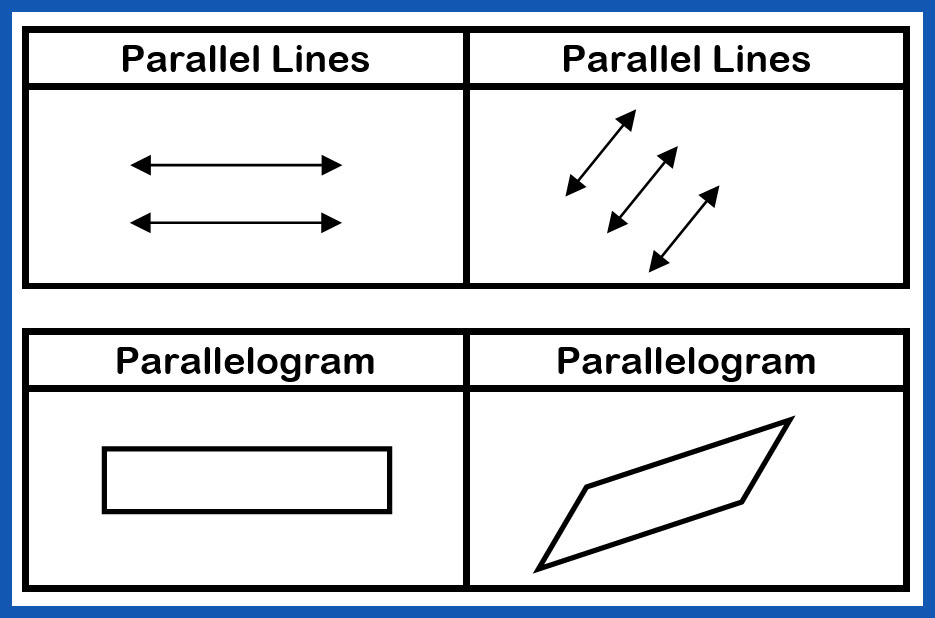
“Oh yeah! I remember those!” Excellent! I thought you would! But did you know the concept of parallelism has an important use in writing? Well, it does! In writing, parallel has a close relationship with coordinate.
- Coordinate: Equal in rank, position, or importance
When ideas are coordinate, ideally, we want to express them in a parallel structure. But actually, the concept of parallelism in writing is much bigger than that. Let’s take a closer look at parallelism.
- Definition: Parallel: Having the same direction or tendency; running side by side; leading to or creating the same result; a resemblance or similarity, and the continuation of that resemblance or similarity; a comparison made; similar to something else in character, motive, aim, or the like.
Parallelism in Outlines
In outlines, parallelism is a rule, not just a suggestion. If ideas are coordinate (equal in rank), they should be written in the same grammatical form. This makes the outline easier to read, easier to follow, and logically consistent. When parallel structure is missing, the outline feels uneven and confusing—which is why teachers often insist on it.
Comparison Examples:
| Not Parallel (Incorrect) | Parallel (Correct) |
|---|---|
|
|
| Not Parallel (Incorrect) | Parallel (Correct) |
|---|---|
|
|
Outline Example:
| Not Parallel (Incorrect) | Parallel (Correct) |
|---|---|
I. Benefits of Exercise
|
I. Benefits of Exercise
|
Bottom line:
When items are at the same level in an outline, they must match in form. Parallelism signals that ideas are equal, connected, and working together—making your outline clear, balanced, and effective.
If you want a complete, proven system for teaching writing:
- Pattern Based Writing: Quick & Easy Essay — If your students can’t organize a paragraph, they can’t write an essay. From confusion to clear essays—in months, not years. Best for elementary, middle school, remedial, and struggling writers.
- Academic Vocabulary for Absolutely Everyone — Better words → Better thinking → Better grades. Best for anyone who wants to improve critical thinking, logical arguments, and effective communication.
Outlining Concept 8: Symmetry
Symmetry isn’t critical, but it sure is helpful. If you examine the divisions of most textbooks, you will likely find a great amount of symmetry. The lessons, the chapters, and the units are likely to be similar in length and structure.
We often think of symmetrical as being exactly the same on both sides: a mirror image.
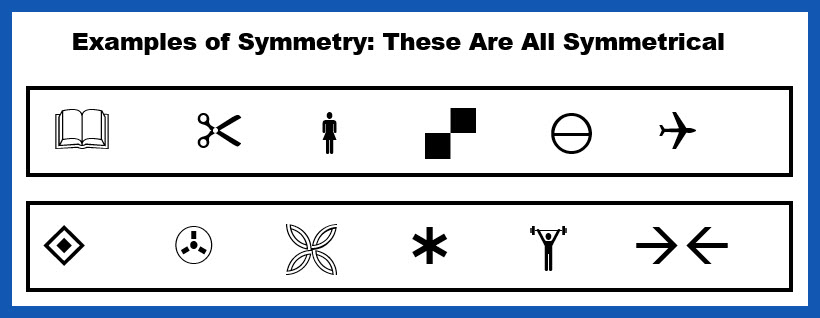
That is the definition in math books. In life, however, we are a bit more forgiving. Many things are more or less symmetrical. They have a “certain symmetry” or “symmetrical qualities.” One thing is for sure, human beings love symmetry. We are drawn to it—and we have been since before the great pyramids of Egypt.
Definition: Symmetry
- Having a common measure; having corresponding parts or relations.
- The law of likeness; similarity of structure; regularity in form and arrangement; orderly and similar distribution of parts.
Many techniques in writing and in outlining are designed to bring about symmetry. Parallel structure and coordination both hint at the topic. And take a look at these patterns of organization: cause-effect, pro-con, compare-contrast, problem-solution, and beginning-middle-end. To a certain degree, each of these patterns implies a certain amount of symmetry.
Please note, I am not suggesting style over substance. However, if you really like a piece of writing and you are not sure why, it probably has a great deal of symmetry. Beautifully organized thoughts almost always contain a great deal of symmetry, even if that is not the intent. Writing without any symmetry is likely to be a mess, or perhaps… pure genius… but more likely, pure madness.
Simple Examples
| Lack of Symmetry (Imbalanced) | More Symmetry (Balanced) |
|---|---|
|
|
Outline Examples
| Imbalanced Outline | More Symmetrical Outline |
|---|---|
|
|
Bottom line: Symmetry is about balance. While it is not required, most effective outlines have a sense of evenness—where ideas at the same level receive similar attention, making the structure feel clear, fair, and complete.
Outlining Concept 9: Consistency
Have you heard of MLA Style, APA Style, and Chicago Style? Each of these styles refers to a corresponding style guide, and each style guide is made up of long lists of specific rules addressing most every possible writing situation. If Paragraph Format was all there was to writing, these style guides would not be necessary.
Unfortunately, these style guides are often in disagreement over what is proper. In short, for many aspects of writing, there is no absolute right or wrong. And for this reason, writers and publishers alike rely on style guides in order to be consistent in their formatting and style.
- A Minor Golden Rule in Writing: Because hard-and-fast rules don’t always exist in writing, a minor Golden Rule in writing is this: Whatever choice you make, be consistent throughout. Inconsistency sticks out like a sore thumb.
Consistent? Consistency? What does that mean exactly? I’m glad you asked!
- Definition: Consistent: Having agreement with itself or with something else; having harmony among its parts; possessing unity; harmonious; congruous; compatible; uniform; not contradictory.
The purpose of all style guides is to create consistency. When you are consistent in your style and formatting, your readers know what to expect. They are able to clearly see how things are organized and fit together. Consistency is a part of organization. Things that are nicely organized will be organized with consistency.
It is important for elementary students to be consistent, just as it is for college students; however, different style guides or style rules may be helpful and appropriate. In fact, many schools and organizations create their own style guides in order to meet their own unique needs.
Comparison: Example
| Inconsistent (Problem) | Consistent (Correct) |
|---|---|
|
|
Bottom Line
Consistency is a minor Golden Rule in writing. When in doubt about how to format, structure, or apply conventions, the safest and most professional choice is always the same: be consistent from beginning to end. This is critical in outlining.
Final Thoughts: Why These Concepts Matter
We have now explored nine essential concepts that shape both outlines and writing. Because outlines are visual, they make these concepts clear, direct, and easy to see. What is often hidden inside paragraphs, essays, and whole compositions becomes visible in an outline.
In paragraph form, these same structures are still present—but they are harder to detect. That is why outlining is so powerful: it reveals the underlying architecture of writing. Outlines are not separate from writing—they are writing made visible.
When used effectively, outlines help writers:
- See how ideas are organized and connected
- Build unity, coherence, and emphasis before drafting
- Strengthen structure at every level of a composition
Just as a building depends on its frame, writing depends on structure. The nine outlining concepts give writers the tools to design that structure with clarity and intention. In the end, strong writing is not just about what you say—it’s about how your ideas are built.
Finally: Outlines are one of the clearest and surest ways to actually write what you think you are writing. They also help you see if you wrote what you think you wrote. Does your writing match your outline?
If you want a complete, proven system for teaching writing:
- Pattern Based Writing: Quick & Easy Essay — If your students can’t organize a paragraph, they can’t write an essay. From confusion to clear essays—in months, not years. Best for elementary, middle school, remedial, and struggling writers.
- Academic Vocabulary for Absolutely Everyone — Better words → Better thinking → Better grades. Best for anyone who wants to improve critical thinking, logical arguments, and effective communication.