

Do you read? If so, what do you think about paragraphs? Do the paragraphs you read in your daily reading match what you have been taught about paragraphs? Chances are, they don’t.
As discussed in Before the Rules: How Paragraphs Actually Developed, writers were using paragraphs long before anyone fully understood them. That history helps explain why paragraph instruction today often feels inconsistent or overly rigid.
What makes a paragraph effective? An effective paragraph develops one idea clearly using structure, organization, and emphasis.
- Unity: one main idea
- Coherence: clear connections between sentences
- Emphasis: important ideas stand out
- Structure varies based on the type of writing
Paragraphs Are Both Science and Art
Like all aspects of writing, paragraph writing is both a science and an art. There has to be some science—some shared expectations—because after all, we live in a society with others. If you are trying to communicate with others, isn’t it your duty to communicate in a manner in which they will understand?
Would that get you a good grade? Answer: No. Would your readers ever read what you wrote? Would you mix up all your sentences and have your readers spend their valuable time trying to figure out what you meant?
Guess what? I mixed up the sentences in the last paragraph. Here is what I was really trying to communicate:
Would you mix up all your sentences and have your readers spend their valuable time trying to figure out what you meant? Would that get you a good grade? Would your readers ever read what you wrote? Answer: No.
Point being, we communicate in agreed upon ways in order that others will understand our communication.
The First Real Attempts to Explain Paragraphs
Lindley Murray (1745–1826) offered the first serious discussion of the paragraph and outlined early rules. Joseph Angus (1816–1902) expanded this work with deeper analysis and examples. From Angus, we see many ideas that still define paragraph writing today:
- A paragraph has one subject or theme
- Paragraphs require unity
- Sentence length and structure should vary
- Different styles of arrangement are possible
- Paragraphs must be logically connected
Bain’s Breakthrough Model
In 1866, Alexander Bain (1818–1903) introduced a full model for paragraph writing.
A paragraph is a collection of sentences with unity of purpose. Like every division of discourse, a paragraph handles and exhausts a distinct topic.
Teacher Note: While Bain refers to the “Four Modes of Discourse,” I tend to use the term “The Four Main Genres” with students because it is both simpler and true.
Bain’s Six Rules
1. Coherence
The connection between sentences should be clear and unmistakable.
2. Parallel Construction
Similar ideas should follow similar structure.
3. Topic Sentence
The opening sentence should indicate the subject of the paragraph.
4. Order
The paragraph should follow a clear and logical structure.
5. Unity
The paragraph should have one clear purpose.
6. Proportion (Emphasis)
Important ideas should receive more space and prominence.
The Simplified Model
- Unity
- Coherence
- Emphasis
The Real Problem: Paragraphs Are Not One Thing
There is no single “truth” about paragraphs.
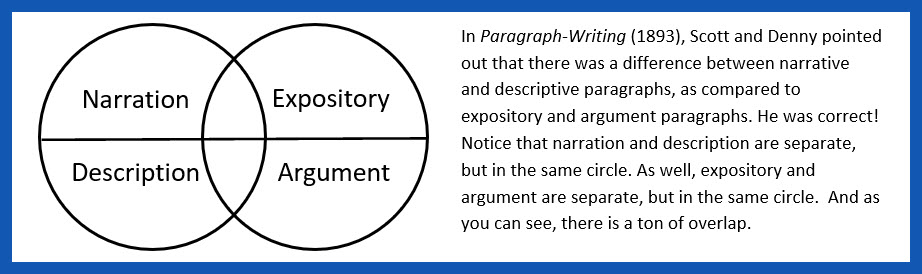
The four main genres are:
- Narration
- Description
- Exposition
- Argument
Teacher Note: I use “The Four Main Genres” with students for clarity.
Why Students Get Confused
Much of paragraph instruction comes from expository and argumentative writing. These forms favor clear topic sentences and predictable structure. But narration and description often do not follow these same patterns. This leads to confusion when one model is applied to all writing.
So What Is a Paragraph, Really?
Is a paragraph a mini-essay or an expanded sentence? It can be both. The paragraph began as a mark. It became a structure. Now it is a flexible tool shaped by purpose.
- It has a purpose
- It develops a unit of thought
- It is shaped for the reader
If you want a complete, proven system for teaching writing:
- Pattern Based Writing: Quick & Easy Essay — If your students can’t organize a paragraph, they can’t write an essay. From confusion to clear essays—in months, not years. Best for elementary, middle school, remedial, and struggling writers.
- Academic Vocabulary for Absolutely Everyone — Better words → Better thinking → Better grades. Best for anyone who wants to improve critical thinking, logical arguments, and effective communication.
Conclusion
There is no single formula that defines all paragraphs. But there are powerful principles that guide effective writing. As discussed in The Paragraph Didn’t Always Exist, this tool is relatively new—and still evolving.